 Sex Differences in Outcomes of Spontaneous Coronary Artery Dissection: Insights from the National Readmission Database

Author: Ahmed Elzanaty, MD, MPH, Additional Authors**
See the poster presentation | See the poster
Introduction
Spontaneous coronary artery dissection (SCAD) is a non-atheromatous and non-traumatic cause of acute coronary syndrome (ACS). Over the past decade, there has been an increased recognition of the disease likely due to the increased physician awareness about the disease as well as the increased use of intra-coronary imaging. Though SCAD is well known to occur more in females than males, studies evaluating the differences in clinical outcomes of the disease among both sexes are scarce.
Methods
The Nationwide Readmission Database 2016-2018 was queried for hospitalizations with coronary artery dissection as a primary diagnosis. Observations where iatrogenic dissection was reported were excluded. Complex samples multivariable logistic, cox, and linear regression models were used to determine the association between SCAD and in-hospital outcomes (mortality, index length of stay [LOS], hospital costs), and all cause 30-day readmissions in females compared to males.
Results
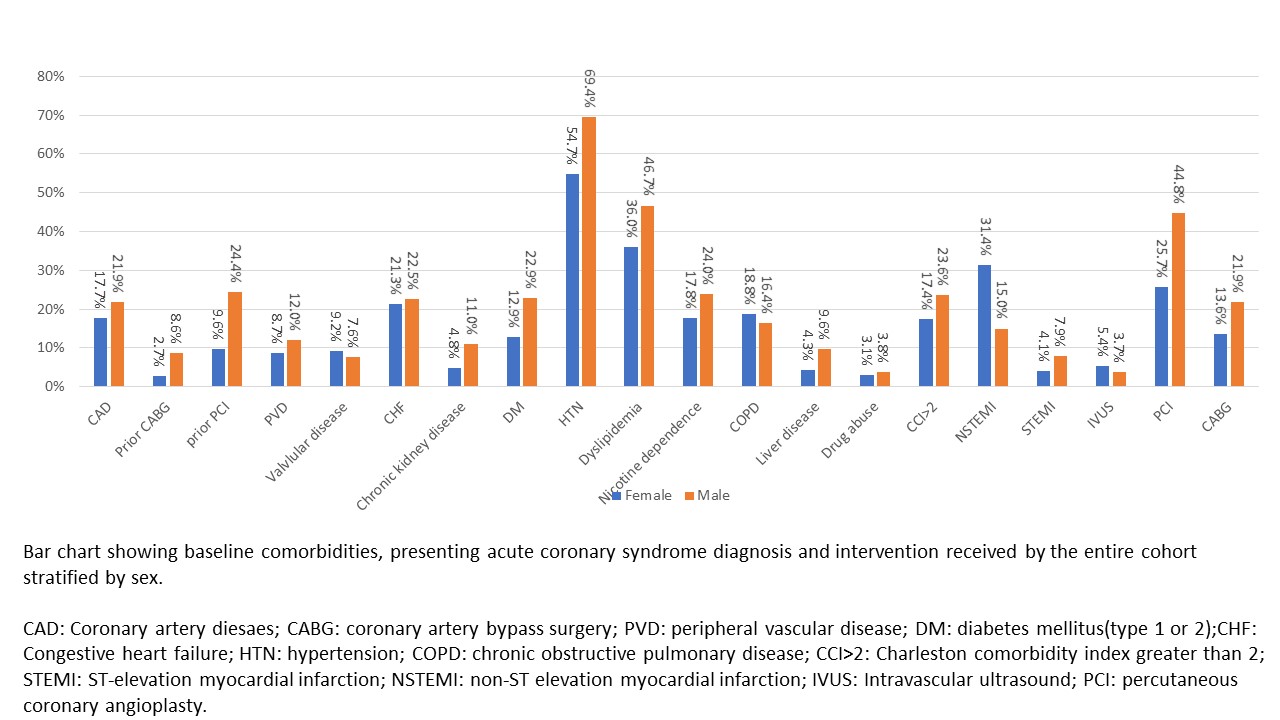
A total of 1,270 hospitalizations [913 (71.9%) females and 357 (28.1%) males] were included in this analysis. Males tend to undergo more revascularization compared to females while females tend to have lower atherosclerotic risk factors. Multivariate analysis showed no difference between both sexes regarding all-cause mortality (adjusted odds ratio [aOR]: 2.43; 95% confidence interval [CI] 0.67-8.77; p=0.17), cardiac arrest (aOR: 3.53; 95% CI: 0.88-14.18; p=0.08), AKI (aOR: 0.65; 95% CI: 0.27-1.25; p=0.17), ventricular arrhythmias (aOR: 0.78; 95% CI: 0.29-2.06; p=0.62), LOS (coefficient [β]: 0.23; 95% CI: -0.61 to 1.07; p=0.59), cardiogenic shock (aOR: 1.28; 95% CI: 0.57-2.90; p=0.55), hospital charges (β: -6218; 95% CI: -35092 to 22655; p=0.67), and all-cause 30-day readmissions risk (adjusted hazards ratio [aHR]: 1.03; 95% CI: 0.58-1.82; p=0.92). The most common causes of readmission were non-specific chest pain and repeat SCAD.
Conclusion
Despite SCAD being more common among females, the clinical outcomes and resource utilization seemed to be comparable between both sexes. Higher SCAD readmission risk noted in our analysis is consistent with what was previously reported and warrant further studies to risk stratify those at high risk as well as devising optimum management strategy for them.
**Additional Authors:
Ahmed M. Elzanaty, MD, University of Toledo, Toledo, OH
Ahmed Maraey, MD, University of North Dakota, Bismarck, ND
Mahmoud Khalil MD, Lincoln Medical Center, New York, NY
Eman Elsheikh, PhD, Tanta University Hospital, Tanta, Egypt
Salik Nazir, MD, University of Toledo, Toledo, OH
Abdelmoniem Moustafa, MD, University of Toledo, Toledo, OH
Islam Y. Elgendy, MD, Weil Cornell-Medicine- Qatar, Doha, Qatar
Ehab A. Eltahawy, MD, University of Toledo, Toledo, OH
